ADHD Treatment in Stratford, CT
ADHD Treatment in Stratford, CT — Precision Work, High Stakes, and a Brain That Keeps Getting in Your Way

Stratford is home to some of the most technically demanding work in the state — aerospace engineering, defense contracts, precision manufacturing in the shadow of Sikorsky. These are jobs where focus isn't optional. Where missing a step has consequences. And yet a significant number of the people doing this work — brilliant, detail-capable engineers and technicians — are also quietly managing undiagnosed ADHD. They've built careers on hyperfocus and late nights, on compensating harder when things slip, on systems and checklists that paper over an underlying deficit. It works, until something breaks. If you're in Stratford and you're starting to notice the cracks — the appointments you keep forgetting, the reports you can't finish, the meeting you zoned out of — Sindhia Shyras, APRN can help. She's a board-certified Psychiatric Nurse Practitioner with nine years of clinical experience, seeing adults via telehealth across all of Connecticut and in person at 2049 Silas Deane Hwy, Suite 209, Rocky Hill.
High-Demand Jobs Don't Make ADHD Disappear — They Mask It
People who work in high-stakes technical environments are often the last ones to be evaluated for ADHD. They're competent. They've built a reputation. So when focus starts slipping or errors start piling up, the assumption is stress, burnout, or not trying hard enough — not a neurological condition that's been present for decades. But ADHD doesn't care how smart you are. And the kind of hyperfocus that gets you through a crunch period doesn't mean ADHD isn't real — it just means you've been compensating. At some point the cost of compensating outpaces the benefit. That's usually when people come in.
Adult ADHD — Often Missed, Rarely Simple
A lot of adults who come in for an evaluation were never diagnosed as kids. Some were bright enough to scrape through school without anyone noticing. Some were in environments structured enough to hide the deficit — the military, a trade apprenticeship, a strict household. Women and girls especially get missed: the diagnostic picture was built around hyperactive boys, and quiet, overwhelmed, inattentive women don't fit that mold. So they spend years being told they're disorganized, flaky, or not living up to their potential — when what they actually needed was an accurate diagnosis and a treatment plan. It's not too late. Adult ADHD responds well to treatment at any age.
What Treatment Actually Looks Like
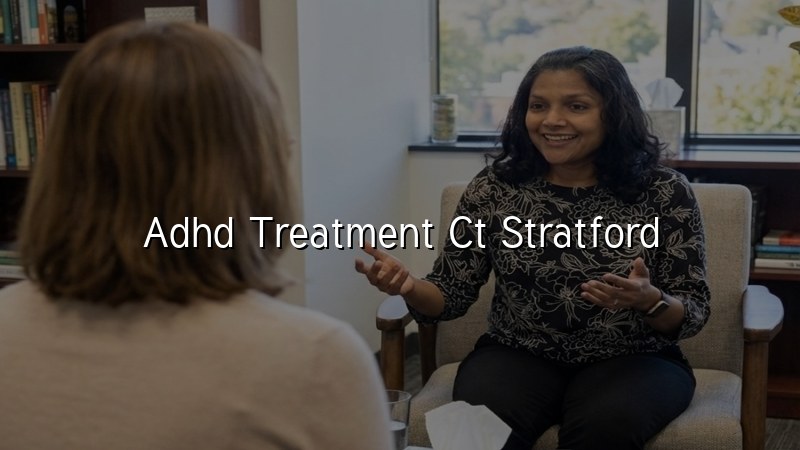
The evaluation is a clinical interview — not a brain scan, not a neuropsychological test battery. Sindhia asks about your symptom history, how things looked in school, and what's showing up now in your work and personal life in Stratford. Usually one to two sessions to complete the evaluation and arrive at a diagnosis. From there, you'll go over treatment options together. Stimulant medications — Adderall, Vyvanse, Concerta, Ritalin — are the most commonly prescribed and typically show clear results within the first few weeks. Non-stimulants like Strattera, Wellbutrin, Qelbree, or Intuniv are solid alternatives depending on your profile. Regular follow-up visits handle dose adjustments and make sure things are actually improving your daily functioning — not just checking a clinical box. Telehealth makes all of this manageable from Stratford without adding another commute to your week.
Frequently Asked Questions
Serving Stratford, CT and all of Connecticut via telehealth.
Call 860-515-8689 or book online below.
Book an Appointment