Anxiety Treatment in Guilford, CT
Anxiety Psychiatrist for Guilford, CT — When the Quiet Town Doesn't Quiet Your Mind

Guilford is one of Connecticut's most beautiful towns — the historic green, the shoreline, the white New England architecture that makes it look like a postcard from a simpler time. And there's real substance here too: well-educated, thoughtful, engaged community. People who read widely and think carefully about the world. Which, actually, can be its own source of anxiety. When you're smart enough to see all the ways things could go wrong, when you're tuned in to the news, to your kids' futures, to the precariousness of things you thought were stable — that awareness can curdle into something that runs constantly in the background. The what-ifs don't shut off. The preparation never feels like enough. If that sounds familiar, Sindhia Shyras, APRN understands exactly what you're describing. She's a board-certified Psychiatric Nurse Practitioner with nine years of experience, and she sees Guilford residents through telehealth anywhere in Connecticut and in-person at our Rocky Hill office.
The Anxiety That Looks Like Productivity
In communities like Guilford, anxiety often doesn't look like falling apart. It looks like overpreparation. Sending the same email three times before hitting send. Researching decisions to a degree that goes well past helpful. Filling every open hour because stillness feels dangerous. Being impeccably organized while your inner life is running at a frequency that never quite settles. High-achieving people often don't recognize this pattern as anxiety because it's producing results. But the cost — the exhaustion, the inability to actually rest, the sense that nothing you do is ever quite enough — is real. And it doesn't have to be the price of doing well.
What Happens When Anxiety and Sleep Don't Mix
Here's a pattern Sindhia sees often: someone falls asleep without much trouble, but then wakes at 3am or 4am — and that's it. The mind is immediately and fully engaged. It's solving problems that don't have solutions yet. It's rehearsing conversations. It's doing a quiet audit of everything that needs to happen and all the ways it could go wrong. By morning you're depleted before the day starts. And this isn't just bad sleep hygiene. It's anxiety hijacking the biological window when the nervous system is meant to be off. Treating the underlying anxiety — sometimes with medication, sometimes with a combination approach — tends to be what actually fixes this pattern, not sleep tips.
Sindhia's Approach to Getting It Right
The first appointment is an hour — a real psychiatric evaluation, not a checklist. Sindhia wants to understand what your anxiety looks like from the inside, how long it's been going on, what it's doing to your sleep and your relationships and your ability to work. She asks about your full history, your current life, what you've tried before. From there she builds a plan that makes sense for you specifically. For many Guilford patients that includes medication — SSRIs and SNRIs work well for generalized anxiety and are very well-studied — along with supportive therapy. She accepts Aetna, Cigna, Husky Health, Medicaid, United Healthcare, Anthem, ConnectiCare, and self-pay.
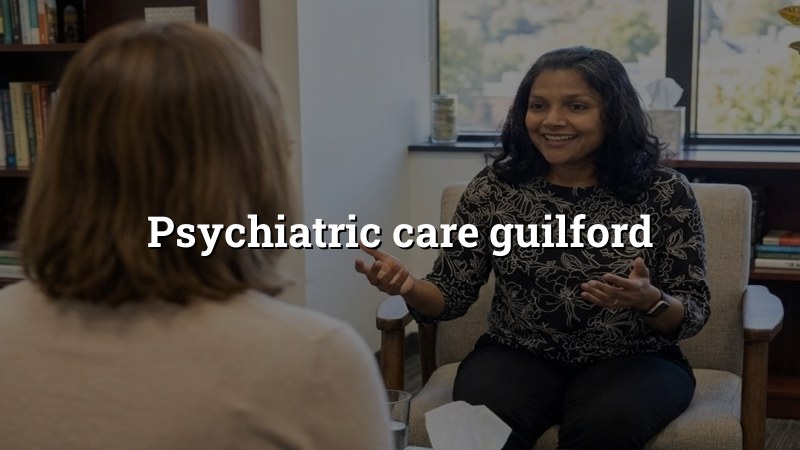
Telehealth Makes This Easier Than You'd Think
A lot of Guilford residents do their appointments over telehealth — no commute, no waiting room, same quality of care. You connect with Sindhia via a secure video call from wherever you have privacy. If you'd rather come in, the Rocky Hill office is straightforward to reach from the shoreline towns. Either way, the care is the same. The only thing that changes is where you're sitting.
Frequently Asked Questions
Serving Guilford, CT and all of Connecticut via telehealth.
Call 860-515-8689 or book online below.
Book an Appointment